
A wall can do more than fill an empty space.
It can hold photographs from a family vacation, display artwork collected over the years, or become the backdrop for everyday life. But sometimes the most interesting wall decoration is something that gives the room a story of its own.
That is the idea behind Enjoy The Wood.
The brand creates wooden home décor with a particular focus on maps, travel, personalization, and natural materials. Its signature pieces turn geography into something tactile and decorative, allowing a world map to become more than a picture hanging on the wall.
Instead of simply looking at where you’ve been, the concept encourages you to interact with those places—and perhaps start thinking about where you might go next.
From a Family Idea to a Wall Full of Possibilities
Enjoy The Wood began in 2014 as a family business, initially creating functional wooden goods and selling them through Etsy.
The turning point came a couple of years later. Founder Igor Fostenko wanted a wooden world map for his office so he could mark the countries connected to his customers. Unable to find exactly what he wanted, he made one himself.
The finished map attracted attention, and the idea eventually developed into the company’s signature product line.
There is something fitting about that origin story.
The product was not created simply because a market trend suggested that people wanted wooden maps. It began with a very practical question: Why can’t I find the thing I have in mind?
Sometimes the most distinctive products start exactly that way.

Turning Geography Into Texture
A traditional world map is usually something you look at.
Enjoy The Wood’s maps are designed to be experienced differently.
The company’s 3D maps use multiple layers, creating visible depth on the wall. According to its FAQ, the 3D versions use three layers with a combined thickness ranging from approximately 6 to 15 millimeters, while its 2D maps use a single thinner layer.
That difference may sound technical, but visually it changes everything.
Instead of a flat printed surface, coastlines, borders, and individual regions can create shadows and dimension. The natural texture of wood adds another layer of visual interest.
The map becomes closer to sculpture than conventional wall art.
The Character of Birch Wood
Material matters when the design itself is built around natural texture.
Enjoy The Wood says its wooden maps are made from high-quality birch plywood. The manufacturing process includes engraving, precision cutting, smoothing, and finishing the wooden components with oil and wax.
This process helps explain why the finished pieces have a different feeling from mass-produced printed décor.
Wood has small variations in grain and surface texture. Those characteristics can give an otherwise standardized design a more individual appearance.
A world map may show the same continents on every wall, but the material gives each finished piece its own visual character.
Not Every Map Has to Look the Same
One of the most interesting aspects of Enjoy The Wood is the variety within its map collection.
There are natural-toned designs for understated interiors, colorful versions for more expressive rooms, and illuminated models that introduce another visual dimension. The current collection also includes country and regional maps, including USA, Europe, Canada, and Germany designs.
This makes the map less about geography alone and more about interior style.
A neutral wooden map can complement a minimalist office. A multicolor version can become the visual centerpiece of a living room. An LED design can create a warmer atmosphere when the lights go down.
The same basic concept can therefore fit very different homes.
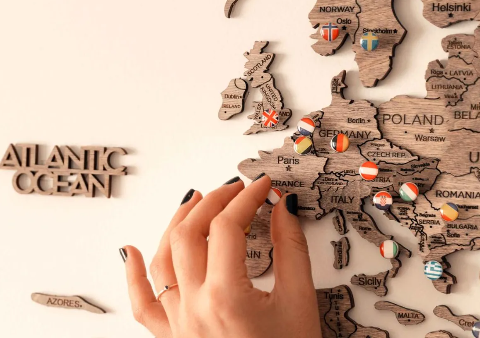
A Map That Can Change With You
Perhaps the most personal element is the ability to mark places.
Enjoy The Wood offers accessories such as push pins and travel markers, allowing the map to become a record of destinations visited or places still waiting to be explored. The brand also describes options for personalization, including names, dates, coordinates, and engraved messages on applicable products.
This changes the role of the map.
It is no longer simply a representation of the planet.
It becomes a visual diary.
A couple might mark destinations from their travels together. A family might add locations from different vacations. Someone who dreams about traveling can use it as a constantly changing list of future adventures.
The wall becomes a timeline.
Why Personalization Changes Home Décor
Personalized décor works because it gives an object meaning beyond its appearance.
A generic wall decoration can look beautiful, but a piece connected to a specific memory becomes harder to replace.
That is why options such as coordinates, names, dates, and messages can be especially interesting for gifts. The object becomes connected to a particular person or moment rather than simply matching a room’s color palette.
For a wedding, it could represent a meaningful location.
For a housewarming gift, it could celebrate a new chapter.
For a frequent traveler, it could become a visual record of adventures.
The material may be wood, but the value comes from the story attached to it.
Beyond the World Map
Although wooden maps are the centerpiece of Enjoy The Wood, the brand’s current catalog extends into other areas of home décor.
Its collections include family trees, city maps, country maps, wooden quotes, office accessories, organizers, night lights, calendars, gift items, and products designed for children and pets.
That broader collection reveals a consistent design philosophy.
Wood is being used not merely as a construction material but as a way of bringing warmth and texture into everyday spaces.
A wooden laptop stand can make a desk feel more natural. A family tree can turn a wall into a personal display. A night light can introduce a softer atmosphere into a bedroom.
The products are different, but the underlying idea remains similar: useful objects can also carry personality.

Decorating With Memories Instead of Trends
Interior trends change quickly.
One year a particular color dominates living rooms. The next year another material becomes fashionable. Styles cycle through minimalism, maximalism, vintage influences, and countless variations in between.
Personal memories are different.
They do not go out of style.
That is what makes a travel-focused piece of décor particularly appealing. Its meaning can become stronger over time rather than weaker.
The first few pins might represent only a handful of destinations. Years later, the same wall may tell an entirely different story.
The décor evolves because the person does.
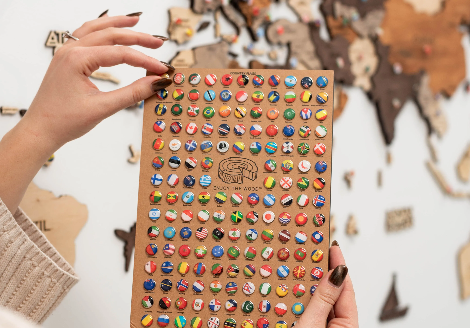
A Natural Fit for Different Spaces
A large statement map might immediately seem suited to a living room, but its possibilities extend further.
An office can use one as a visual reminder of international connections. A study can use it as an exploration-inspired focal point. A family room can turn it into a shared travel project. Even a child’s room can incorporate geographical décor as part of a broader adventure theme.
Enjoy The Wood specifically organizes its décor across spaces such as living rooms, bedrooms, kitchens, offices, and children’s rooms.
That flexibility is useful because good décor does not necessarily have to remain decorative.
The best pieces can become part of how a room is used.
The Appeal of Making Space Personal
There is a difference between decorating a room and making it yours.
Decorating can mean choosing objects that look good together.
Making a space personal means choosing objects that say something about the people who live there.
Enjoy The Wood sits somewhere between those two ideas.
Its products are designed to work visually within a room, but maps, engravings, travel markers, family trees, and other personalized details can give them a more intimate purpose.
That combination is what makes the concept interesting.
You are not simply buying something to cover an empty wall.
You are creating a wall that can eventually tell a story.
A Different Way to Look at Home
Perhaps the most memorable thing about Enjoy The Wood is that it treats home décor as something capable of growing with you.
A blank map can become a collection of memories.
An engraved piece can become a reminder of a particular moment.
A family-oriented design can become part of a home for years.
And a simple wooden object can add warmth without overwhelming the rest of the room.
Since its beginnings in 2014, Enjoy The Wood has built its identity around the relationship between natural materials, craftsmanship, travel, and personal stories.
That makes its approach different from décor designed purely to follow a seasonal aesthetic.
The most interesting decoration may not be the piece that looks perfect today.
It may be the piece that becomes more meaningful every time you come home.